Insulation of the facade of a private house
When in winter through doors that are not tightly adjacent to the boxes, dry windows see through, means, they waste valuable energy, produced by the heating system. But that's not all. There is another factor in heat loss - external walls, which were erected, when no one thought about energy saving. External insulation of the house Prevent excessive air heating in the summer and retain heat in the room in winter. And the exterior of the building can be diversified using external finishes, which performs not only a decorative function, but also protects the internal structures from moisture and inaccessible environmental factors.

Advantages of insulation of facades of private houses
Thermos effect is long -term retention of the temperature poured into it with hot or cold liquid, We apply in construction. Reducing heat loss by 30-50%, The extension of the overhaul period is possible not only when replacing doors (windows) for sealed structures, but even when using modern technologies of external thermal insulation of the building.
Insulation of the facades of private houses will solve the following problems:
- Heating and air conditioning expenses are significantly reduced;
- condensate falling inside the wall material, displacement of "dew point" (condensation zones) In the outer layer of insulation - protection against excess humidity and fungus/ mold indoors;
- Sound insulation of external walls, When using insulation in combination with soundproofing windows and doors, Even the noise of a lively street will not penetrate the house;
- The durability of the building, Lack of annual facade repair, due to thermal insulation and protective-decorative layer, The material of the wall design is not subjected to aggressive influences of the external environment;
- creation of an attractive appearance of the structure, In various architectural styles and color solutions.
The choice of insulation
General requirements for insulation:
- Low coefficient of thermal conductivity - creating a reliable barrier from the penetration of cold at low temperatures, or hot air in the summer;
- Small weight - reducing transportation costs, Removing the need to strengthen the foundation;
- vapor permeability - free exit of wet air from the inside of the house out;
- different options for the facade sections - the ability to use architectural elements of various , Very possibility in the design of the facade;
- comparability of the service life of the structure;
- Health and environmental safety;
- non -hunger.
Mineral wool
This is any fibrous material, Received from basalt, Dolomites, other rocks, glued with water -soluble binding in slabs of different densities. In connection with a simple production technology, accessibility of raw materials, The cost of mineral wool is acceptable for the average buyer.
For insulation of the facades of private houses, the material is produced in the form of plates of various sizes. Mineral wool meets all the requirements, presented to heaters, Moreover, it is universal and combined with almost all types of finishing.
The disadvantages include:
- High hygroscopicity,
- Infusal in processing.
Some researchers also note carcinogenicity, but the risk of harm to health occurs only in the conditions of production. When working with ready -made slabs and during operation, there is no threat to health.
Foamed polystyrene
Thanks to the closed structure of styrene cells, this material has a low indicator of hygroscopicity, It has a strong structure, inert and non -toxic. Light weight provides ease of installation and ease of processing.
In addition to compliance with the general requirements for insulation, The facade insulation with foam has a significant advantage - low price. Business disadvantages include, that the material does not "breathe" and fuel. But the vapor permeability of the insulation does not replace the ventilation system, through which excessive moisture comes out. The wine for high humidity lies not on the walls, sheathed with foam (Foam polystyrene), And on the project, on which the house was built. Fire safety provides not only the material, as well as compliance with the technology for the installation of the insulation system, where mineral wool "cuts" are used.
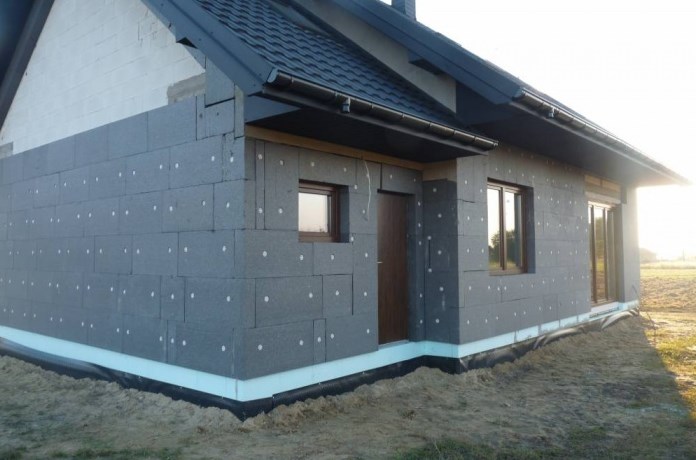
Extruded polystyrene foam
This material in comparison with foamed polystyrene is more expensive, It does not have vapor permeability, but has low hygroscopicity. The combustibility class is higher, than foamed polystyrene. For resistance to fire, special impregnations are used - antipyre. The material is almost completely waterproof, and is used in insulation of the underground part of the building and basement and balconies.
Materials for the finishing of the insulation system
All types of protective-decorative finishing coating have the following advantages:
- Universality - suitable for applying to new or old walls of facades;
- Protection against external environmental influences - wind, precipitation, mud, organic growths;
- Homogeneous surface structure;
- Any color options, Including bright colors;
- stability to surface pollution;
- long service life with invariability of characteristics.
note! Facade decorative plasters are not designed to apply to horizontal surfaces!
Mineral decorative plaster
The use of high -quality polymer additives reduces the water absorption of the surface, and fibrous and high -quality fillers protect the surface of the plaster from cracking. Exists 2 type of surface structure – Grain and furrier. When using mineral decorative plaster, it is necessary to paint the surface with the finish paint in 2 layers.
Polymer finished plaster
This is a type of protective and decorative coating based on water-dispersive polymeric binders with inert mineral aggregates. Supplied in a ready -made form in a plastic container. Does not require adding water. It is used as a finish layer in thermal insulation systems with various types of insulation.
Facade paints
Used on top of mineral decorative plasters. Types of colors:
- on an acrylic basis, With low vapor permeability;
- On a silicate basis, With high vapor permeability;
- On a silicone basis, With high vapor permeability;
- With high elasticity, with capable of blocking cracks;
- with additives that slow down the formation of mold or algae growth.
Ceramic tiles (Clinker tiles)
Ceramics can be used as a finish decorative coating. Special products are intended for cladding with tiles and grout of the seams.
Products are represented by various sizes and color solutions. Capatect tiles are popular among builders, She is light, weight 1 sq. m is only 5-6 kg. Installation is carried out on glue without the use of additional fixing elements. Ready products of various shades are designed for grouting seams. The appearance of the facade with this coating is indistinguishable from the surface, lined with ordinary clinker tiles.
Organizational moments
Installation of insulation systems is permissible at a temperature of not more than +50C, And the use of materials based on silicone or silicate materials - +80C. When using special materials and compliance with work technologies, it is possible to carry out work in the cold season at a temperature below -50C.
Before starting work follows:
- protect and protect people's passage zones, Other dangerous places;
- Prepare protective equipment - screens for windows, Tots for jobs;
- Conduct lighting;
- Install fire extinguishing means.
Technology for the performance of work:
- Study of the project and technological cards of work.
- Preparatory stage - selection of materials, equipment, Installation of forests, Removing drains and means of communication.
- Preparation of the base - cleaning, Alignment with plaster.
- Installation of basement profiles.
- Installation of heat insulation plates on glue.
- Mechanical fastening of insulation plates with plastered dowels.
- Strengthening slopes, corners and other structural elements with plastic profiles and corners with a reinforcing grid.
- Mineral glue.
- Applying the basic reinforcing layer and pressing the fiberglass into a plaster solution.
- The priming of the base layer.
- Application of a protective - decorative layer. And coloring in the case of the use of mineral decorative plasters.
- Installation of special components for attaching the drainage system, lighting, Communications according to the project of insulation.
Output
Modern systems for insulation and decoration of facades of private houses are reliable and effective. They significantly reduce heating costs, conditioning, effectively protect the facade from the effects of atmospheric phenomena, extend the overhaul service life of the facade. Give the opportunity to perform several options for decoration of the facade of the building, Relating its appearance and allowing the structure to harmoniously fit into the architectural ensemble, or it is prestigious to stand out against the background of other buildings. You can order a turnkey private house in Kyiv by t: (096) 070 04 76


0 Comments